





Held in Port Douglas, Queensland, this year’s Australasian Society of Cataract and Refractive Surgery (AUSCRS) conference was themed ‘A Whole New World’. It was appropriate, being the first AUSCRS meeting with new co-presidents Dr Jacqui Beltz and Professor Gerard Sutton. The casual dress code, lively discussions between speakers and audience, as well as the speakers’ outrageous costumes, are welcome and enduring features from the society’s past 27 years of meetings.
Past president Professor Graham Barrett and former secretary/treasurer Dr Rick Wolfe were honoured with the Barrett/Wolfe Gold Medal Lecture, delivered by Dr Damien Gatinel, who heads up the anterior and refractive surgery department at The Rothschild Foundation in Paris, France. Entitled ‘Unveiling the secrets of precise intraocular lens (IOL) calculation through theoretical analysis and cutting-edge modelling’, his presentation discussed IOL behaviour based on the design and balance of optical power between the anterior and posterior surfaces, the impact of anatomy on effective IOL position and the measurement of both anterior and total corneal optical power. Since IOL design and effective position have a much greater impact on post-operative refraction, optimising the IOL constants of IOL formulae should be done using the higher optical power lenses, he said.
The standout lecture in the session on complex cases came courtesy of Singapore’s Professor Soon-Phaik Chee, who discussed zonulysis using both capsular hooks and different types of capsular tension rings and Cionni ring segments. She also demonstrated the use of Hoffman corneoscleral pockets for Gortex suturing of posterior chamber IOLs.

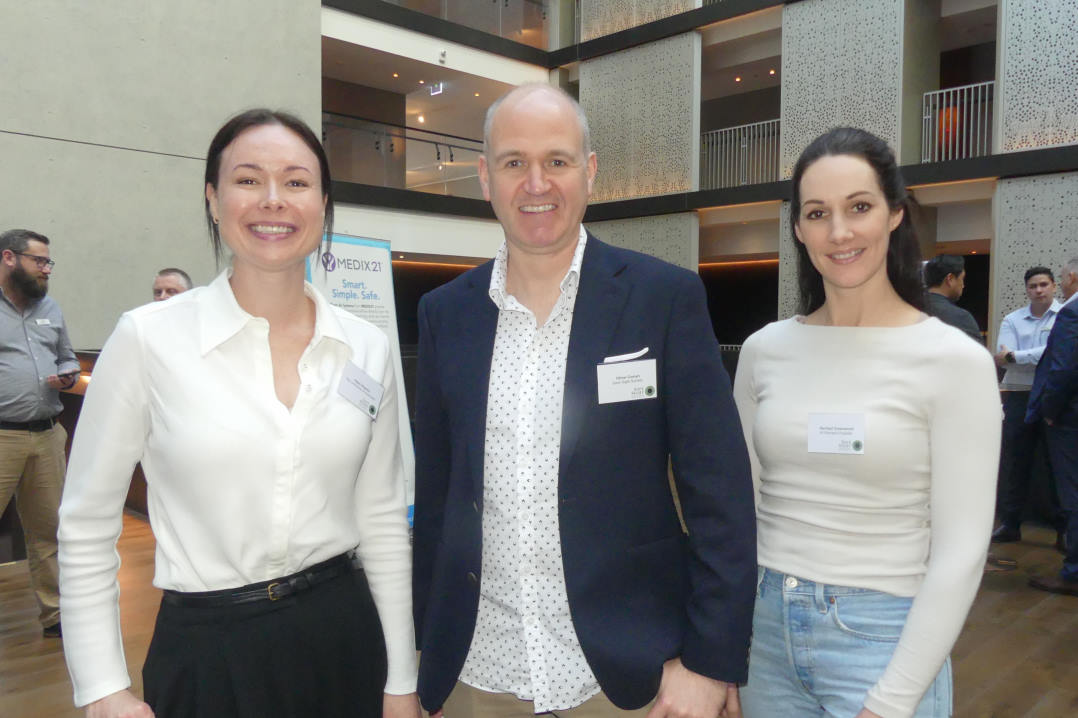
Prof Brendan Vote with Drs Michael Merriman, David Kent and Oliver Comyn
and Alcon’s Tristan Tuhi
Formulating the power of IOLs
A doyen of IOL optical power calculations, US-based Dr Warren Hill presented on maximising cataract refractive outcomes. He recommended optimising the ocular surface for one to two weeks prior to biometry with twice-daily hot compresses, following a set protocol and using validation criteria with IOL formulae from this century, such as Barrett, Hill-RBF, EVO, Kane or Cooke. Echoing Dr Gatinel’s points, Dr Hill emphasised the importance of very accurate, careful post-operative refractions for optimising lens constants and using properly optimised IOL formulae constants.
Later in the conference, he also covered the pre-operative measurement of corneal optical power and astigmatism and recommended using the Barrett True-K calculator for toric IOLs in post-keratorefractive eyes. President-elect of the European Society of Cataract and Refractive Surgeons’ (ESCRS’), Dr Filomena Riberio from Portugal, reinforced this in a later lecture, explaining the need to know these IOL design factors as well as an accurate refractive index. She also discussed how the ESCRS IOL calculator uses multiple new-generation IOL formulae.
A session on the Staar Visian EVO ICL discussed its history, sizing and surgical tips. In many parts of Europe, it has replaced corneal laser refractive surgery due to the lack of post-operative dry eye complications. The cost of the surgery there is similar to SMILE and LASIK, in contrast to New Zealand, where Staar Visian ICL surgery costs almost double either laser option.
A very useful session on toric IOL calculation included talks from Dr Hill and Prof Barrett, who suggested using Barrett-model-based calculations in virgin eyes. However, for patients with keratoconus or previous laser refractive surgery, he recommended incorporating posterior corneal curvature measurements with the Barrett-measured calculation.

Dr Zea Munro discusses toric IOL calculations in post-refractive
surgery eyes. Behind her are A/Prof Michael Goggin with Drs John
Males and Damien Gatinel, Prof Graham Barrett and Dr Warren Hill
An extended day of focus
On day two, invited participants made a case for their preferred extended-depth-of-focus (EDOF) IOL. This led to a lively discussion followed by some duelling on stage with plastic swords to decide which EDOF lens was the winner. Many of the day’s presentations also included arguments about whether EDOF IOLs would cause trifocal IOLs to fall out of favour.
Associate Professor Abi Tenen (Melbourne) delivered a very interesting and highly relevant lecture on peri-operative refractive stability amid a myopia epidemic. She discussed myopia’s increasing prevalence in Australia, the USA and Asian countries and its association with increased screen time. A very entertaining session followed, with pairs of contestants taking turns to decorate cakes while their partner described the cataract surgery of the decorator. I concluded ophthalmologists were far more skilled at cataract surgery than decorating cakes!

Co-presidents Prof Gerard Sutton and Dr Jacqui Beltz make an
understated entrance
From surgical technology to Arabian nights
The final day included more excellent instructive surgical videos from Prof Chee and talks on how artificial intelligence could be used in dry eye disease, cataract and refractive surgery. A session on the latter included Professor Michael Knorz, senior vice president medical affairs (international) of EuroEyes, discussing his preferred procedures, including SMILE for younger low to moderate myopes, Staar Visian ICL surgery for high myopes and lens replacement for hyperopes and older myopes. There were also presentations on the three new femtosecond lasers (Zeiss Visumax 800, Schwind Atos and J&J Elita) now competing for the corneal lenticule extraction surgery market.
The session on keratoconus covered the evidence for the eye-rubbing aetiology theory, how to calculate IOL optical power in keratoconus, and intrastromal corneal ring segments. Discussion of the Staar Visian toric ICL phakic IOL’s role in keratoconus was followed by notes on using the Barrett True-K formula for IOL optical power calculations and pinhole ciliary-sulcus-fixated ‘piggy-back IOLs’.
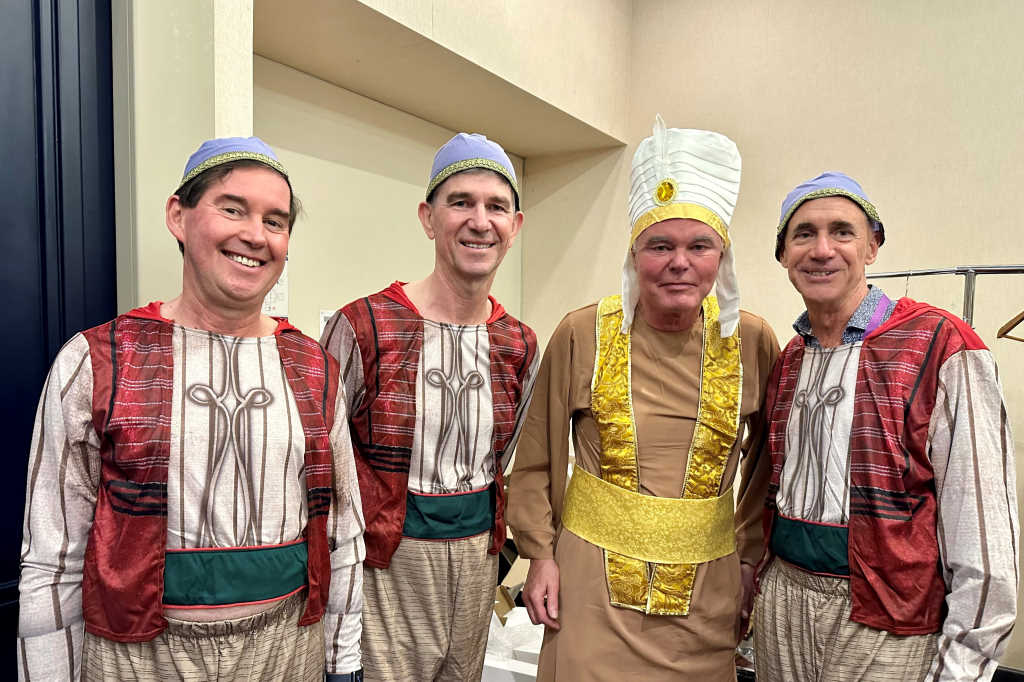
After Dr Ben LaHood became the runaway winner in the AUSCRS film festival – with his movie on IOL dislocation being the most entertaining and imaginative, as well as educational – the meeting ended with the traditional gala dinner. In keeping with the ‘Arabia for a Night of Nights’ theme, most attendees came dressed in Arabian Nights-flavoured garb, with Dr Brendan Vote’s winning costume including an inflatable muscular chest and lots of blue makeup, evoking the Robin Williams-voiced genie from Disney’s Aladdin.
Next year’s AUSCRS will be held at Hamilton Island 24-27 July, themed ‘The I-Land, Creating Connections.’
Dr David Kent is a consultant ophthalmologist with Fendalton Eye Clinic and Christchurch Eye Surgery. He is a member of both the American and Australasian Societies of Cataract and Refractive Surgery, and the New Zealand AUSCRS council representative.